
Don’t Be Caught Swimming Naked When The Tide Goes Back Out
February 27, 2026
The investor’s chief problem — and even his worst enemy — is likely to be himself.
—Benjamin Graham
Price tends to drive sentiment. When an asset rises quickly, we usually see a familiar pattern:
- Enthusiasm mounts
- Our inbox fills up with questions about potentially increasing allocation
- Confidence feels justified, rising prices create narratives, and momentum begins to feel like validation
When prices decline, the tone shifts just as quickly:
- Urgency fades
- Skepticism replaces conviction
- Assets that felt compelling weeks earlier suddenly feel risky
The recent volatility in Bitcoin and the broader cryptocurrency market is simply the latest example of this pattern. It is not unique to digital assets. The same cycle has played out repeatedly across technology stocks, real estate, commodities, and precious metals over time.
This month’s Note examines what volatility reveals about risk, popularity, and positioning — and why we think risk management and investing process matter most when sentiment reaches extremes.
But first, here’s a summary of the global asset classes utilized in our portfolios and their exposures for March.
Asset Allocation Update
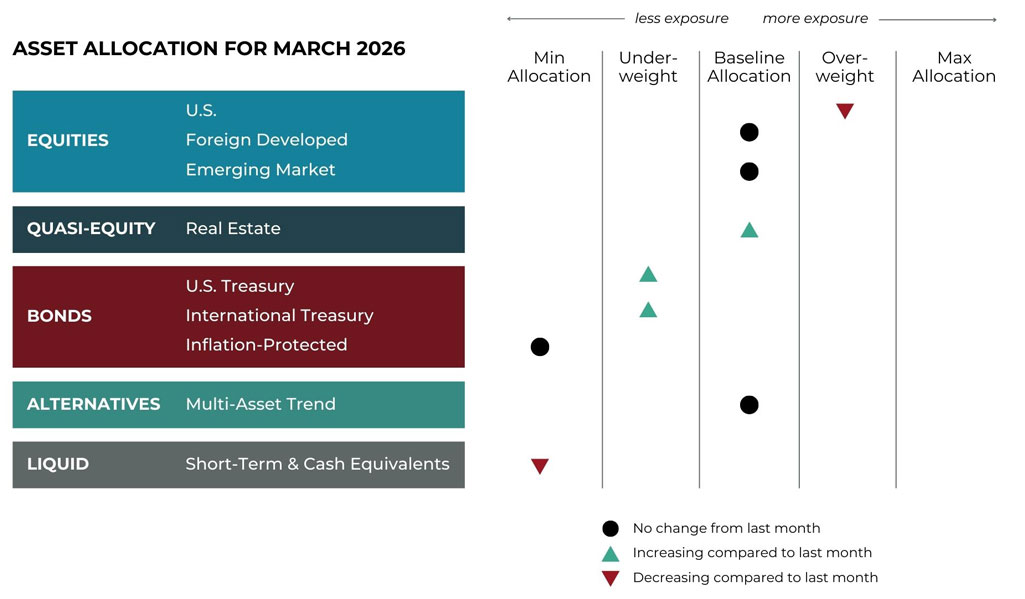
Source: Blueprint Investment Partners
Adjustments can vary across strategies depending on each strategy's objectives. What's illustrated above most closely reflects allocation adjustments for the Growth Strategy. Diversification does not guarantee investment returns and does not eliminate the risk of loss. Diversification among investment options and asset classes may help to reduce overall volatility.
U.S. Equities
International Equities
Exposure will not change, with both foreign developed and emerging market equities remaining at their baseline allocation. Trends continue to be positive across all timeframes.
Real Estate
U.S. & International Treasuries
Both U.S. and international Treasuries are now experiencing some positive trends and strengthening. As a result, both will increase to just below their baseline allocations.
Inflation-Protected Bonds
Exposure will be at its minimum as it remains weaker than other fixed income assets.
Alternatives
Exposure is expressed through a multi-asset alternative ETF. Fixed income (net long) maintains its top spot in terms of exposure, with most of the recent increase happening in low volatility short-duration bonds. Outside of fixed income, the most influential segments continue to be net long equities followed by international currencies and precious metals.
Short-Term Fixed Income
Exposure will decrease to minimum as exposure is returned to strengthening U.S. and international Treasuries.
Asset-Level Overview
Equities & Real Estate
As February winds down, the S&P 500 Index appears stuck in neutral and is flirting with negative territory for the month, which would leave the index flat to down for 2026 thus far.
For the first time since 2022, technology and growth stocks have lagged instead of led, with both segments poised to end February in the red for both the month and year. In fact, both are in position to end the month with intermediate-term downtrends for the first time in nearly a year.
As is common in these cases, value and dividend stocks have been the best performers, but small caps have also done relatively well. The latter would seem to be a good thing for the market at large but it remains to be seen if the tech hangover will continue to be a drag. Trends remain positive across all timeframes for these segments and the S&P 500 as a whole. However, another month of declines could put us in position to further reduce exposure.
Foreign developed and emerging market equities experienced yet another good month of performance, leaving them at or near a double-digit return for the year already. With more new all-time highs for both, trends remain positive across all timeframes and each is at its baseline allocation in our portfolios.
Real estate securities appear to have awoken from their slumber and are now at their highest levels in more than a year, breaking out of the range that has seemingly served as a ceiling. Not only are uptrends now in place, but the asset has caught up with U.S. equities enough to warrant a sizable increase in exposure. This asset will now be at its baseline allocation for March.
Fixed Income & Alternatives
Though it lacks the conviction of real estate, another interest rate sensitive asset on the rise recently is fixed income. Trends are now mostly positive across the yield curve in the U.S. as well as within international bonds. The result is that exposure will be taken from short-term Treasuries, which have served as a placeholder, and returned to fixed income instruments of slightly higher duration.
Within the alternatives allocation, continued strength in fixed income has increased short-term bond exposure and modestly extended duration, making net long fixed income the largest allocation in the portfolio. From a risk perspective, however, contributions remain more balanced, as equities (net long), international currencies (net long), and precious metals (net long) are driving a greater share of overall portfolio movement when adjusted for relative volatility.
Sourcing for this section: Barchart.com, FTSE All-World Ex-US ETF Vanguard (VEU), 3/9/2007 to 2/25/2026 and Barchart.com, FTSE EM ETF Vanguard (VWO), 3/11/2005 to 2/25/2026
3 Potential Catalysts For Trend Changes
U.S. Growth: U.S. economic growth slowed noticeably at the end of 2025, mainly due to a lengthy government shutdown and weaker consumer spending. The Commerce Department said gross domestic product, which measures the value of all goods and services produced, grew at a 1.4% annual rate in the final quarter, after adjusting for inflation and seasonal changes. This was well below the 2.5% economists expected and a big drop from the third quarter’s 4.4% growth. According to another calculation for economic growth, the economy grew 2.2% in 2025, down from 2.4% in 2024, and the slowest pace since 2022.
Housing Update: Mortgage rates dropped below 6% recently for the first time in more than three years, which is good news for people looking to buy homes as the busy spring season approaches. Freddie Mac reported the average rate for a 30-year fixed mortgage was 5.98%, the lowest since September 2022. Rates had briefly gone above 7% in January last year but have been falling for several months. Lower inflation, economic uncertainty, and three interest-rate cuts by the Federal Reserve in the second half of 2025 have all helped push rates down. Experts say that falling below 6% could encourage more buyers to enter the market and may also prompt more homeowners to refinance their mortgages. Spring is usually the busiest time for real estate agents and home builders, as many families prefer to move during the summer. Sellers often wait until spring to list their homes, expecting more buyers. However, lower borrowing costs have not yet led to a big jump in home purchases. According to the Mortgage Bankers Association, purchase mortgage applications fell recently to the lowest level since April.
Job Report: January’s strong jobs report, along with major revisions that lowered job numbers for the past two years, highlights how much the U.S. labor market is changing. There is strong demand for healthcare and social services workers, but things look tough for government employees, factory workers, and office staff. During the past year, healthcare jobs have quietly supported the job market while other sectors slowed hiring or cut positions. It has become clear just how important healthcare has become, as nearly all the 130,000 new jobs in January were in that field. Healthcare has long been a key source of new jobs as the population ages, but after the pandemic, other sectors also hired quickly to meet demand for services like dining out and travel. Low interest rates after the 2020 recession boosted hiring in tech and finance, but demand for those jobs has now faded. Over the past year, the number of workers in professional and business services, finance, retail, and information has gone down. Federal government payrolls also dropped sharply. Slow hiring by companies has made it harder for job seekers to find work, which could be one reason why consumer confidence remains low.
Sourcing for this section: The Wall Street Journal, “Economic Growth Slowed in Fourth Quarter, Hurt by Government Shutdown,” 2/20/2026; The Wall Street Journal, “Mortgage Rates Fall Below 6% for the First Time Since 2022,” 2/26/2026; The Wall Street Journal, “What Sweeping Revisions and a Blowout Month Tell Us About the U.S. Job Market,” 2/12/2026; and The Wall Street Journal, “Healthcare Jobs Have Become the Engine of America’s Labor Market,” 2/11/2026
Sentiment, Like Tides, Shift. Your Investing Process Should Not.
Only when the tide goes out do you discover who’s been swimming naked.
—Warren Buffett
The oft-quoted line from the Oracle of Omaha is used primarily in financial crises, but it applies just as well to the recent volatility in Bitcoin and the broader cryptocurrency market. When prices for any asset, including crypto, starts surging, our inbox fills up. We also get calls asking how to gain exposure and how much allocation makes sense.
The enthusiasm is contagious. Confidence feels abundant.
Then the tide goes out.
Prices decline. Momentum fades. The questions stop. The urgency disappears. Curiosity gives way to caution.
This shift in behavior highlights one of the most persistent patterns in investing: investors tend to want what has already gone up, and they lose interest when prices fall — even though declining prices can create more attractive entry points. This isn’t unique to crypto. It happens with technology stocks, real estate, commodities, and nearly every asset class. There’s an argument that it’s happening in precious metals as we speak.
Performance drives attention. Rising prices create narratives. Falling prices create doubt.
But risk and long-term return potential aren’t correlated to popularity. They often are more correlated to an asset becoming less popular.
When Bitcoin and other cryptocurrencies were climbing rapidly, the primary risk was not visibility, in our view — it was exuberance. Expectations can expand during strong advances. Future returns can get pulled forward. Position sizes can quietly grow. Leverage can creep in. That’s when Buffett’s tide metaphor matters most. A sharp decline doesn’t create risk; it more often reveals it.
At the same time, corrections can create opportunity — particularly for investors with disciplined processes. Lower prices can mean lower implied expectations. Speculative excess can be reduced. Weak hands may exit. Stronger capital may remain. Yet human nature pushes many investors in the other direction. Investors frequently ask about adding exposure after significant gains. They rarely ask about adding exposure after a significant decline — even though that is arguably when expected returns may be more favorable.
This does not mean every dip should be bought blindly, nor does it mean crypto is appropriate for every portfolio. Digital assets remain volatile and speculative.
Instead, the purpose of this is to remind everyone that risk management matters. Position sizing matters. Investing process matters. The recent decline illustrates the importance of separating action from emotion. ALL assets will cycle through enthusiasm and skepticism. Headlines will oscillate between celebration and concern. As sentiment swings, however, your investing process should hold firm, in our view.
The tide will continue to move in and out. The shared role is not to chase popularity nor dismiss innovation outright — it is to evaluate risk, assess reward, and apply a repeatable framework, especially when sentiment is extreme in either direction. Because the best time to ask disciplined questions about an asset class is rarely when everyone else is celebrating it. More often, it’s when the tide has pulled back.
Let's Talk
If you have any questions about what transpired in the markets last month or portfolio positioning for the month ahead